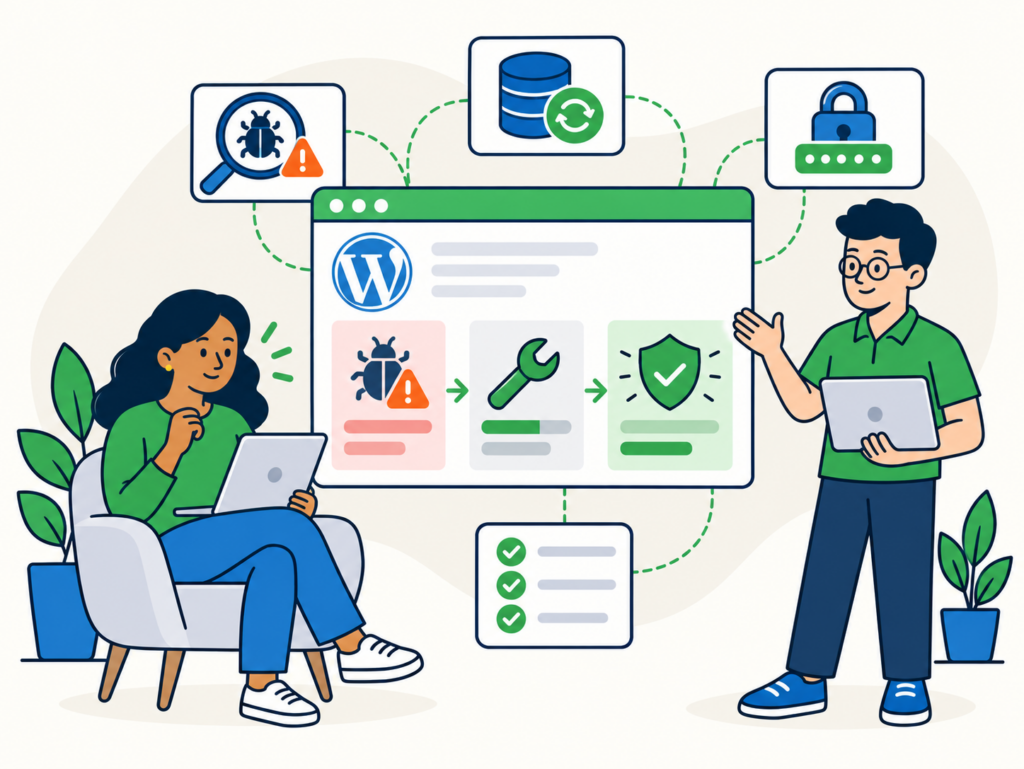
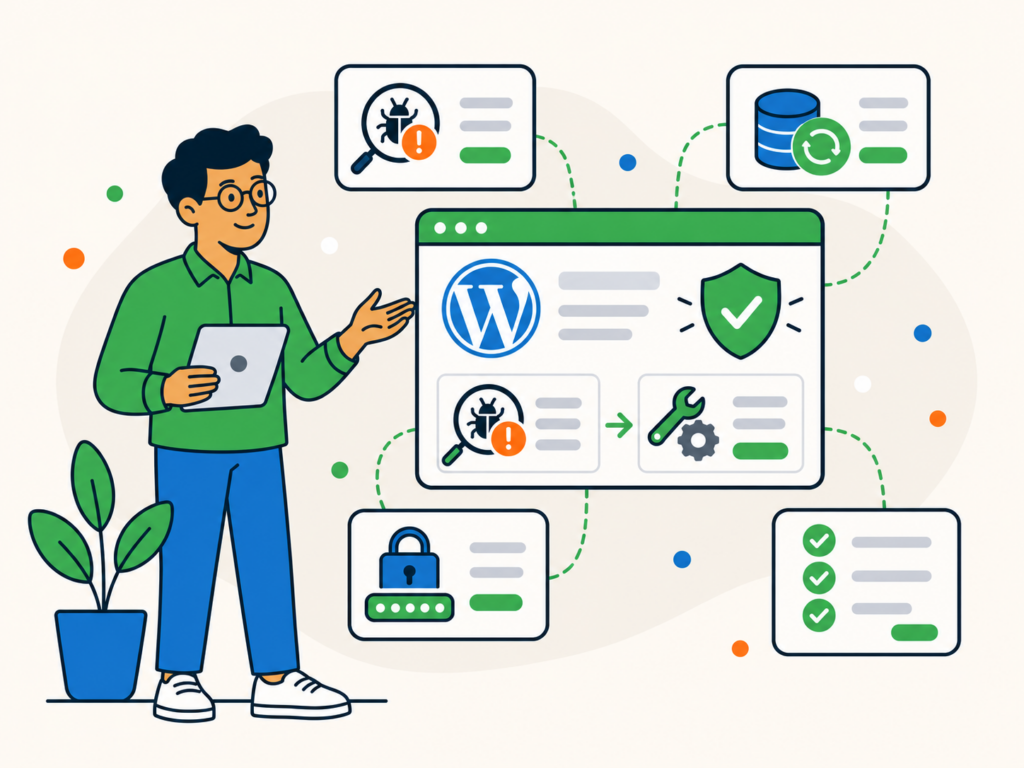
Professional WordPress malware removal involves more than running a scanner and deleting whichever files it flags.
A compromised website may contain malicious files, injected code, unwanted database content, unknown administrator accounts or hidden backdoors. The original route into the site may also still be open.
That means a proper cleanup needs to answer three questions:
- What has been compromised?
- How did the attacker get or retain access?
- What needs to change to reduce the risk of the site being infected again?
The exact process varies from one incident to another, but a professional WordPress malware cleanup will usually involve the following stages.
1. Assess the symptoms and scope of the compromise
Before removing anything, the first step is to understand what is actually happening.
Some compromises are obvious. A website might redirect visitors elsewhere, display spam or trigger a browser security warning.
Others are much less visible.
Useful information can include:
- malware scanner results
- suspicious redirects
- unfamiliar administrator accounts
- hosting-provider warnings
- Google Search Console security alerts
- unexpected files or code
- spam pages
- unusual server behaviour
- reports from visitors
- recent changes to the website
If you are still trying to determine whether there is a genuine security problem, our guide to signs your WordPress website may have been hacked explains the common warning signs in more detail.
The assessment also needs to establish the likely scope of the incident.
For example, is the problem limited to one WordPress installation, or could it affect:
- other websites on the same hosting account
- the hosting account itself
- administrator credentials
- the website database
- server-level files or configuration
- staging or development copies of the site
This matters because cleaning only the visible infection will not solve a wider compromise.
A deeper investigation may involve several types of security checks. Our guide to scanning a WordPress website for malware and vulnerabilities explains how remote scans, server-side scans, vulnerability checks and file-integrity checks provide different pieces of evidence.
2. Preserve useful evidence and establish a recovery point
Before making destructive changes, it can be useful to preserve the current state of the website.
Depending on the incident, this might include:
- a copy of the website files
- a database backup
- malware scan results
- file modification times
- relevant server or application logs
- screenshots
- hosting alerts
- details of suspicious users
- URLs showing malicious behaviour
An important distinction is that a backup taken after a compromise is not automatically a clean restore point.
It may contain the malware itself.
However, it can still be useful for investigation, comparison or recovering legitimate content while the cleanup is carried out.
Existing backups from before the incident can also be valuable, but they need to be treated carefully. A backup is only suitable as a clean recovery point if it predates the relevant compromise and does not restore malicious changes, vulnerable software or unauthorised access that contributed to the incident.
Preserving useful evidence before making lots of changes also makes it easier to understand what happened if the incident needs further investigation.
3. Contain the incident where necessary
Some compromises need immediate containment before a full cleanup can begin.
The appropriate action depends on what the website is doing and how serious the incident appears to be.
Containment might involve:
- temporarily restricting access to the website
- disabling a compromised user account
- blocking clearly malicious requests
- stopping suspicious processes
- isolating an affected site
- preventing outbound spam
- working with the hosting provider to restrict malicious activity
Taking a website offline is not automatically the right response to every infection.
A site with a small amount of injected spam may be handled differently from an ecommerce website actively redirecting customers to a phishing page.
The aim is to limit further damage while preserving enough access and information to investigate the problem properly.
Containment should therefore be proportionate to the incident rather than applied as the same fixed procedure every time.
4. Remove malicious files, code and database content
Once the problem has been assessed, the malicious changes themselves need to be removed.
Depending on the compromise, this may involve:
- removing malicious files
- removing backdoors
- cleaning injected code from legitimate files
- replacing compromised WordPress core files
- replacing affected plugin or theme files with known clean copies
- removing malicious database content
- removing spam pages
- deleting unauthorised administrator accounts
- removing injected redirects or scripts
- repairing modified configuration
Malware does not always live in an obvious standalone file.
Attackers may add malicious code to legitimate WordPress, plugin or theme files. They may also store unwanted content in the database, create hidden access methods or use files that look as though they belong to the website.
That is why professional cleanup involves distinguishing malicious changes from legitimate customisations.
Deleting every unfamiliar file is not a safe strategy.
A customised plugin, theme file or business-specific piece of code may look unusual without being malicious. Removing the wrong thing can turn a security incident into a broken website as well.
The goal is to remove the compromise while preserving legitimate website functionality.
5. Find the vulnerability or likely route of compromise
Removing malware is only part of the job.
You also need to investigate how the attacker gained access or how they could return.
Possible routes include:
- a vulnerable plugin
- a vulnerable theme
- outdated WordPress software
- stolen or reused credentials
- an abandoned administrator account
- compromised hosting access
- malicious or untrusted software
- an exposed staging site
- another compromised website on the same environment
- a persistent backdoor left from an earlier infection
Sometimes the exact original entry point can be established.
Other times, there may not be enough evidence to say with certainty how the compromise first occurred.
That uncertainty should be acknowledged rather than replaced with guesswork.
The important objective is to identify known or plausible routes back into the website and address them.
Otherwise, a site can appear clean for a short period and then become infected again.
6. Reset affected credentials and WordPress security keys
If an attacker may have obtained valid access, removing their malware does not necessarily remove their ability to return. Compromised accounts may need to be disabled or reset immediately during containment, while broader credential rotation can be coordinated as the cleanup progresses.
Depending on the incident, credentials that may need to be changed include:
- WordPress administrator passwords
- hosting or control-panel credentials
- SFTP or SSH access
- database credentials
- domain or DNS accounts
- other privileged services connected to the website
WordPress authentication keys and salts may also need to be regenerated.
These values help protect WordPress authentication cookies. Replacing them invalidates existing logged-in sessions, which can help remove access through sessions that should no longer be trusted.
Credential changes should be planned carefully.
If there is reason to think a computer or account used to administer the website is itself compromised, simply setting a new password from the same untrusted environment may not solve the problem.
It also makes sense to coordinate credential changes with the cleanup so necessary access is not accidentally removed before the investigation is complete.
Strong, unique passwords and multi-factor authentication should be used where available after access has been secured.
7. Update, patch or remove vulnerable software
Once the malicious changes have been removed, any vulnerable or unsafe software associated with the incident needs attention.
That might mean:
- updating WordPress core
- updating plugins
- updating themes
- applying a security patch
- replacing abandoned software
- removing unused plugins or themes
- removing untrusted software
- correcting unsafe configuration
If a vulnerable plugin was involved in the compromise, cleaning the malware while leaving the vulnerable version active leaves an obvious route back into the website.
The same principle applies even when the exact entry point is uncertain.
Known security weaknesses found during the investigation should be addressed before the incident is considered resolved.
Removing malware without closing the route back in is not a complete cleanup.
8. Validate the cleanup
A cleanup should not end as soon as the obvious malicious file has disappeared.
The site needs to be checked again.
Validation may include:
- running another malware scan
- repeating file-integrity checks
- reviewing previously infected locations
- checking administrator accounts
- checking for unexpected redirects
- reviewing relevant database content
- checking the site while logged out
- testing important site functionality
- confirming security warnings have been resolved where applicable
- reviewing relevant hosting or server alerts
Different checks provide different forms of evidence.
A clean remote scanner result, for example, does not prove that there are no malicious server-side files. Equally, clean WordPress core checksums do not establish that the database or a plugin is clean.
The objective is to build enough evidence that the identified compromise has been removed and that the website is behaving as expected again.
9. Monitor for reinfection or recurring symptoms
The period immediately after cleanup is important.
A website can appear clean and then become infected again if something was missed.
Common causes of reinfection include:
- a hidden backdoor
- compromised credentials
- vulnerable software that was not patched
- another infected site on the same environment
- a second malicious file that was overlooked
- persistent unauthorised access
Short-term monitoring can therefore help confirm that the cleanup holds.
Depending on the website, this might include watching for:
- malware alerts
- unexpected file changes
- suspicious login activity
- unknown users
- redirects
- unusual server behaviour
- renewed search or browser warnings
If the same symptoms return, that should be treated as evidence that the original incident was not fully resolved rather than simply repeating the same file deletion again.
10. Improve security after the incident
Once the immediate compromise has been dealt with, attention should return to prevention.
Useful measures can include:
- keeping WordPress, plugins and themes updated
- using strong, unique credentials
- enabling MFA where appropriate
- limiting administrator access
- maintaining dependable backups
- monitoring for suspicious activity
- using a web application firewall where appropriate
- keeping the hosting environment properly maintained
These measures cannot guarantee that a website will never be compromised again.
They reduce the opportunities available to attackers and improve your ability to detect and recover from future problems.
Our WordPress security best practices guide covers these preventative measures in more detail.
Can malware removal guarantee the site will never be hacked again?
No responsible malware-removal service can guarantee that a website will never experience another security incident.
A professional cleanup can aim to:
- identify and remove malicious changes
- find and close known or likely routes back into the site
- remove unauthorised access
- reset affected credentials
- patch known vulnerabilities
- validate the cleanup
- monitor for signs of reinfection
It cannot guarantee that:
- a new vulnerability will never be discovered
- somebody’s credentials will never be stolen
- another service connected to the website will never be compromised
- a future attack will never succeed
Security changes over time.
The important distinction is between removing the current compromise properly and promising that no future compromise can ever happen.
When does professional malware removal make sense?
Not every WordPress problem requires a professional malware-removal service.
If you have the technical experience, appropriate server access and enough time to investigate the incident properly, you may be comfortable handling some compromises yourself.
Professional help becomes particularly useful when:
- the website is important to the business
- the infection keeps returning
- you do not know which files are safe to remove
- multiple files or database records appear to be affected
- administrator access has been compromised
- the hosting provider has suspended the website
- several websites on the same account may be affected
- redirects or malware only appear under certain conditions
- the site handles customer or sensitive information
- you do not have suitable backups
- the likely cause of the compromise is unclear
- you suspect the compromise may extend beyond WordPress itself
- you need the problem investigated rather than simply hiding the visible symptoms
The more complex the compromise, the more important it becomes to understand the whole incident rather than repeatedly removing whichever symptom appears next.
Need help removing malware from WordPress?
If your WordPress website has been hacked or infected, our WordPress Malware Removal service provides a one-off route to getting the problem investigated and cleaned up.
We can assess the compromise, remove malicious content, address relevant security issues and validate the website afterwards.
The aim is not simply to make the visible warning disappear. It is to understand the problem, clean the website properly and reduce the chance of the same compromise immediately returning.