Building a professional-looking WordPress website doesn’t necessarily mean learning to code or paying for expensive design software.
WordPress already includes a powerful block editor, but sometimes you need more flexibility over how a page looks. That’s where WordPress page builders come in.
These plugins let you create custom layouts, arrange content and adjust design elements through a visual interface. Many offer free versions that are capable enough for everyday website projects.
In this guide, we’ll compare four free WordPress page builders: Elementor, SiteOrigin, Beaver Builder and Brizy. We’ll explain what each offers, where its limitations lie and how to decide whether you need a separate page builder at all.
Do You Need a WordPress Page Builder?
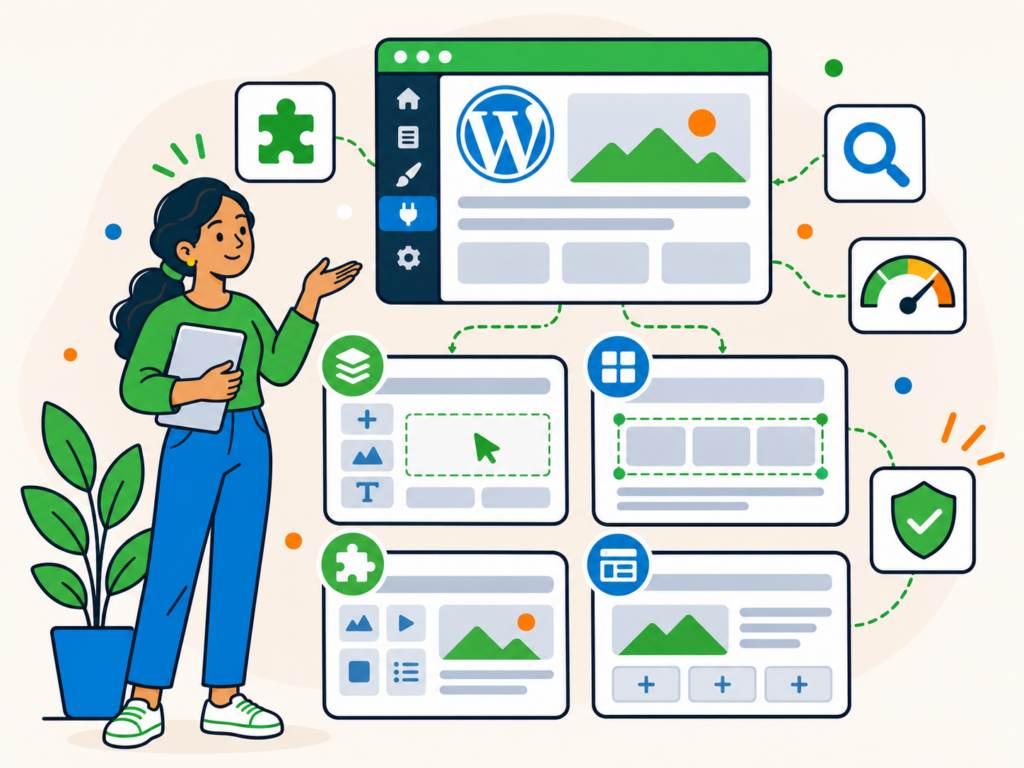
A WordPress page builder is a tool that helps you design pages visually without having to write HTML or CSS.
Most page builders provide a drag-and-drop interface where you can add content elements, create columns, change spacing and adjust colours or typography.
They’re particularly useful for creating landing pages, custom homepages and other layouts that need more design flexibility than a standard page.
However, you might not need one.
What about the WordPress block editor?
The built-in WordPress block editor already lets you create layouts using headings, images, buttons, columns, galleries and other content blocks.
You can also use patterns, which are ready-made groups of blocks that can be inserted and customised.
If your website uses a block theme, the WordPress Site Editor provides additional control over areas such as headers, footers, templates and site-wide styles.
For many blogs and small business websites, these built-in tools may be all you need.
A separate page builder becomes more appealing when you want a different visual editing experience, more detailed layout controls or particular design features that your existing WordPress setup doesn’t provide.
Before installing anything, consider what you’re trying to achieve. Adding a page builder simply because it’s popular can make your website more complicated than necessary.
4 Free WordPress Page Builders Worth Considering
The following four plugins offer free versions and different approaches to building WordPress pages.
1. Elementor
Elementor is a visual drag-and-drop page builder that gives you detailed control over page layouts and individual design elements.
Its editor lets you arrange content directly on a visual canvas, with settings for adjusting the appearance of each element.
The free version includes widgets for headings, images, text, buttons, videos, galleries, icons and other common page elements.
You can create sections, adjust spacing, customise typography and preview how your design looks on different screen sizes.
Elementor also has a large collection of tutorials and third-party extensions, which can be helpful when you’re learning to build more involved layouts.
What makes Elementor useful?
Its main strength is the amount of visual control available without writing code.
For example, you could create a landing page with a large introductory section, a three-column services layout, testimonials and a prominent contact button.
You can then adjust the spacing, colours and appearance of those elements without switching between your website and a separate design application.
What are the limitations?
Elementor’s many settings can feel overwhelming when you’re starting out.
Some advanced features, including additional widgets, theme-building tools and marketing functionality, also require a paid version.
It’s worth checking which features are included before committing to a particular design.
Consider Elementor if: You want a flexible visual builder with plenty of design options and room to expand into more advanced features.
2. Page Builder by SiteOrigin
Page Builder by SiteOrigin takes a different approach to page design.
Rather than focusing entirely on a modern visual canvas, SiteOrigin uses a layout system built around rows, columns and WordPress widgets.
You can arrange content into columns, adjust individual row settings and apply styles to different parts of a page.
The plugin also offers a live editor for previewing changes and a history feature that lets you move backwards and forwards through layout revisions.
SiteOrigin works with standard WordPress widgets, while its separate free Widgets Bundle adds more content and design options.
What makes SiteOrigin useful?
It’s particularly well suited to building structured page layouts without needing an elaborate design system.
For example, you might use it to create a services page with introductory text, alternating image and text sections, and a final call to action.
Its row and column approach makes the page structure relatively straightforward to understand.
The history feature is another useful addition when you’re experimenting with a layout and want to reverse a change.
What are the limitations?
The interface can feel less immediate than page builders that focus on direct front-end editing.
You may also need the separate Widgets Bundle to access some of the content elements you want.
That isn’t necessarily a disadvantage, but it’s worth understanding how the two plugins work together.
Consider SiteOrigin if: You prefer a structured approach to layouts and want a free builder that works closely with WordPress widgets.
3. Beaver Builder
Beaver Builder is another visual WordPress page builder, with an emphasis on a straightforward front-end editing experience.
You can arrange content into rows and columns, add modules and adjust their settings while viewing your page.
The free Lite version includes modules for headings, text, images, buttons, video and several other common content elements.
It also supports responsive layouts, giving you control over how your content is presented on different devices.
What makes Beaver Builder useful?
Beaver Builder offers a practical way to create custom pages without getting distracted by an enormous collection of design options.
For example, you could put together a company homepage with a hero section, an introduction, service descriptions and a contact section.
The visual editor helps you see how these elements fit together as you work.
The available free modules are enough to experiment with a range of standard business website layouts.
What are the limitations?
Beaver Builder Lite doesn’t include everything available in the premium versions.
Some advanced modules, broader template options, reusable layout features and theme-building functionality require an upgrade.
If you intend to build a larger website with lots of reusable designs, check those limitations before choosing the free version.
Consider Beaver Builder if: You want a straightforward visual editor for building custom pages and are happy to start with a more limited feature set.
4. Brizy
Brizy is a visual page builder designed to make creating and editing WordPress pages feel more direct.
Its interface places many editing controls close to the content you’re working on rather than requiring you to manage everything through a separate settings panel.
You can drag and drop elements, arrange content into rows and columns, and add text, images, buttons, videos and other design components.
Brizy also provides ready-made design options to help you get started, although access to particular layouts and features depends on the version you’re using.
What makes Brizy useful?
Brizy’s approach can appeal to people who prefer working directly with the content on their page.
For example, you could start with a simple landing page, add an introductory section, insert supporting images and arrange buttons to guide visitors towards an enquiry form.
You can make visual adjustments as you build instead of writing CSS or repeatedly switching between different screens.
What are the limitations?
As with the other builders, some features are reserved for paid plans.
You should check whether the free version includes the specific design elements, integrations and templates your project needs.
Brizy also uses its own editing environment, so moving an established design to a different builder may involve rebuilding parts of the layout.
Consider Brizy if: You want a visual editor with convenient on-page controls for creating relatively simple marketing and business pages.
Quick Comparison of Free WordPress Page Builders
All four plugins can help you create custom WordPress layouts, but they approach the job differently.
| Page builder | Editing approach | Main free-version strength | Main consideration |
|---|---|---|---|
| Elementor | Visual drag-and-drop editor | Extensive design controls and widgets | Advanced features require Pro |
| SiteOrigin | Rows, columns and widgets | Structured layouts and revision history | Less direct editing experience |
| Beaver Builder | Visual front-end editor | Straightforward editing with useful basic modules | Reusable layouts and advanced features are limited |
| Brizy | Visual editor with on-page controls | Convenient editing for marketing pages | Some designs and integrations require Pro |
If you’re unsure where to start, Elementor offers a broad range of tools, while Beaver Builder and Brizy may appeal if you prefer a more focused visual editing experience.
SiteOrigin is worth considering if you’re comfortable working with rows, columns and widgets.
These are starting points rather than definitive rankings. The best choice depends on how you prefer to work and what your website needs.
What About WordPress Block Editor Plugins?
Not every plugin that helps you build pages is a standalone page builder.
Some plugins extend the existing WordPress block editor instead of introducing a completely separate design environment.
For example, Spectra Blocks adds page-building functionality using WordPress’s native block system.
It’s a separate plugin from Spectra Legacy, the older version previously known as Ultimate Addons for Gutenberg. Existing Spectra Legacy users don’t need to switch simply because the newer plugin is available.
Other block editor extensions include Kadence Blocks, GenerateBlocks and Stackable.
These plugins can give you more control over layouts and design while keeping you within the familiar WordPress editing experience.
If that sounds more suitable for your website, read our guide to five WordPress block editor plugins worth considering.
It’s worth exploring this option before committing to a standalone page builder, particularly if you’re starting a new website.
How to Choose the Right WordPress Page Builder
The best page builder isn’t necessarily the one with the most features.
Before choosing a plugin, think about how you’ll use it and whether it fits your existing website.
1. Start with the features you need
Make a short list of the layouts and content elements you want to create.
If you only need text, images, buttons and basic columns, WordPress’s built-in blocks might already cover everything.
If you’re planning more complex landing pages or highly customised layouts, a separate builder may be worthwhile.
2. Check what’s included for free
All four builders offer free functionality, but their premium features differ.
Check whether the free version supports the particular templates, forms, design controls or integrations you need.
A free plugin isn’t necessarily the cheapest long-term option if an essential feature later requires a subscription.
3. Consider your theme and existing website
A page builder should work alongside your WordPress theme, but that doesn’t guarantee every combination will behave perfectly.
Themes can control page width, typography, headers and other styling that may affect your builder layouts.
If you already use a page builder, avoid switching to another one without checking how your existing pages will be affected.
Layouts created with one builder may not transfer cleanly to another.
4. Think about performance and maintenance
Page builders can introduce additional styles, scripts and functionality.
That doesn’t automatically make them slow, but more features and complicated layouts can increase the amount of work a browser needs to do.
Images, fonts, animations, hosting and caching also affect performance.
Rather than assuming one builder is always faster, test the actual pages you’re creating.
Choose a plugin that is actively maintained, keep it updated and avoid installing multiple builders without a clear reason.
5. Test before committing
The easiest way to decide whether a builder suits you is to try it.
On a test website or staging environment, create a simple page with a heading, image, text section, button and two-column layout.
See how easily you can adjust the design and preview it on mobile.
This will tell you more about the editing experience than a long list of advertised features.
If you want to test a builder on an existing website, take a backup first and avoid experimenting directly on important live pages.
Which WordPress Page Builder Should You Choose?
There’s no single WordPress page builder that’s right for everyone.
Elementor is a good starting point if you want a broad collection of visual design tools. SiteOrigin is useful for structured layouts built around widgets. Beaver Builder offers a straightforward editing experience, while Brizy makes direct visual editing a central part of its approach.
However, you shouldn’t overlook WordPress’s built-in editor.
For many websites, the standard blocks or a carefully chosen block plugin will be enough, without introducing another editing system to maintain.
Whichever option you choose, focus on creating pages that are clear, accessible, responsive and easy to update. A website that works well for your visitors matters more than how many design features its page builder offers.
If you need help improving an existing WordPress page, Newt Labs offers one-off website changes for layout adjustments, content updates, new sections and other practical improvements.
We can also review more involved requests and help you decide whether they need a different approach.